Explore-Consolidate Dynamics in Cross-Probe Coherence
U-Shape Trajectories of κ_t Separate Successful and Failed LLM Agent Runs on SWE-bench Pro / Qwen3.6-27B
Explore-Consolidate Dynamics in Cross-Probe Coherence Separate Successful and Failed LLM Agent Trajectories
Caio Vicentino (ORCID: 0009-0003-4331-6259)
OpenInterpretability — [email protected]
Draft v2. 2026-05-18. Target venue: NeurIPS MI Workshop 2026 (Sep submission) or ICLR 2027 main track.
Abstract
Behavioral probes for LLM monitoring are typically evaluated one axis at a time. We propose a meta-signal — cross-probe coherence κ_t — measured as the mean absolute pairwise correlation across N concurrent per-turn probes within a moving window of agent turns. On 99 SWE-bench Pro trajectories from Qwen3.6-27B (3 872 turns, 5 per-turn probes trained on a single layer of the residual stream), we report two distinct findings. (1) Per-trace mean κ̄ separates success from failure at AUROC 0.677 (Mann-Whitney p=0.0009). (2) κ_t exhibits a U-shape over each trajectory: it decreases through the first half (exploration) and increases through the second half (consolidation), and the amplitude of this U-shape is markedly larger in successful traces. The early-half slope is −0.0078/turn in success vs. −0.0007/turn in failure (p=0.0002); the late-half slope is +0.0149/turn in success vs. +0.0025/turn in failure (p=0.00004). A pre-registered robustness control (C1) found the monolithic per-trace slope is largely explained by trace-length confound (p=0.56 after length regression), motivating the length-normalized early-half/late-half decomposition. Within-trace turn-order shuffle nulls (C2) confirm the U-shape is genuinely temporal (p<0.0001). The pattern is the inverse of cardiac uncoupling: in ICU literature, cross-vital decorrelation anticipates physiological decompensation; in LLM agents, cross-probe trajectories oscillate during successful reasoning (explore→consolidate) and remain flat during failure. We discuss the methodological discipline — pre-registered gates that caught both five prior single-probe walk-backs and this paper's own headline-confound — that gives the finding its credibility.
1. Introduction
1.1 Single-probe monitoring is the default
Production LLM monitoring stacks — Apollo's Watcher series, Anthropic's "Cheap Monitors" and Persona Vector probes, OpenAI's internal classifiers — typically deploy one probe per failure mode: one deception classifier, one sycophancy classifier, one capability classifier. When multiple probes are available, they are evaluated in isolation or combined by simple aggregation (averaging logits, OR-gating on thresholds; see Hua et al., 2025).
This pattern is sensible: each probe is its own scientific artifact, with its own training distribution, calibration, and failure modes. But it implicitly assumes that any signal in the joint distribution of probe outputs is already captured by the marginals. We argue — and empirically demonstrate — that this assumption can be false. The covariance structure across N concurrent probes carries meta-signal that no single probe captures alone.
1.2 Biological inspiration: cardiac uncoupling
Twenty years of intensive-care literature, beginning with Morris (2006), documents that healthy patients show high cross-vital coherence: heart rate, blood pressure, and respiration rate are strongly coupled through autonomic feedback. Patients on a trajectory toward physiological decompensation show cross-vital uncoupling — the correlations collapse — hours before the crisis becomes overt. Modern Early Warning Scores deployed across tens of thousands of patients use this pattern as a validated mortality predictor.
The structural similarity to multi-probe monitoring of LLM agents is direct. Each probe is a "vital sign" measured at each turn. The question of whether their cross-coupling carries predictive information about reasoning success or failure is empirically testable.
1.3 What we contribute
- We define cross-probe coherence κ_t for N concurrent behavioral probes evaluated per agent turn, on a moving window of W turns.
- We show that per-trace mean κ̄ separates SWE-bench Pro success from failure at AUROC 0.677 (lift +0.176 over a shuffled baseline; Mann-Whitney p=0.0009).
- We characterize the temporal shape of κ_t over agent trajectories as a U: a falling early phase ("exploration") and a rising late phase ("consolidation"). The amplitude of this U is substantially larger in successful trajectories than in failed ones: early-half slope −0.0078/turn (success) vs. −0.0007/turn (failure), p=0.0002; late-half slope +0.0149/turn (success) vs. +0.0025/turn (failure), p=0.00004.
- We document and resolve a length-confound: a naïve per-trace slope (averaging the early-fall and late-rise) is explained by trace-length variation across classes (regression-residual Mann-Whitney p=0.56). The length-normalized early/late half decomposition is the correct primary statistic; the monolithic slope was a misleading summary.
- We show the pattern is inverse to its biological analogue: cardiac decompensation involves cross-channel collapse from coupled baseline; LLM-agent failure involves cross-probe flatness, the absence of explore→consolidate oscillation rather than a coupling collapse.
- We document the methodological discipline — five pre-registered single-probe candidates walked back in the 36 hours before this finding, plus this paper's own pre-registered controls catching a headline-confound — as the load-bearing source of credibility.
1.4 Methodological context
This finding is the sixth probe project in a single 36-hour sprint. The five preceding candidates — silent-refusal (irreproducible across transformers commits), tool-doubt (lexical leak via ok=false substrings), tool-doubt position-sweep (no semantic signal at any layer/position), Inner-Outer paired probe (capability redux), and κ_t v1 with trace-level labels (no within-trace dynamics) — were each governed by a four-gate pre-registration protocol that they failed. The present work passes the original four gates (G1, G2, G3 on κ̄; G4 marginal) but the bonus per-trace slope statistic, when subjected to a separately pre-registered five-control battery, was found to be substantially confounded with trace length (C1, p=0.56). The correct length-normalized statistic — the early-half/late-half decomposition — was constructed after the controls flagged the confound, and replicates the substantive finding (succ vs fail differ significantly in both halves, in opposite directions). We narrate this walk-back-and-rescue trajectory explicitly because we believe the pre-registration discipline is what carries the credibility of the rescued finding.
2. Method
2.1 Cross-probe coherence κ_t
Let P_1, …, P_N be N behavioral probes, each producing a scalar score s_i(t) for a given agent turn t in a trace τ. For a window half-width W (we use W=3, so a 7-turn window), define the windowed coherence at turn t as:
κ_t(τ, t; W) = (1 / (N · (N−1))) · Σ_{i≠j} | corr_τ(s_i, s_j) over t' ∈ [t−W, t+W] |
Where corr_τ is the Pearson correlation of probe scores computed only over the turns in the window of trace τ. Absolute value is used because we care about coupling magnitude, not sign; individual probes may be encoded with opposite polarity.
Per-trace summary statistics used in this paper:
- Mean coherence: κ̄(τ) = mean of κ_t(τ, t; W) over all turns t with a non-degenerate window.
- Early-half slope: linear regression of κ_t(τ, t; W) against t over the first ⌊n_turns(τ) / 2⌋ turns. Denote ŝ_early(τ).
- Late-half slope: linear regression of κ_t(τ, t; W) against t over the second half of τ. Denote ŝ_late(τ).
- Monolithic slope (deprecated as primary statistic, retained for honesty): regression over all valid windows in τ. Denote ŝ(τ).
The early/late decomposition is length-normalized by construction: each trace contributes one slope value per half regardless of its absolute length. This is the key technical move that survives the trace-length confound discussed in §4.
2.2 Probe stack
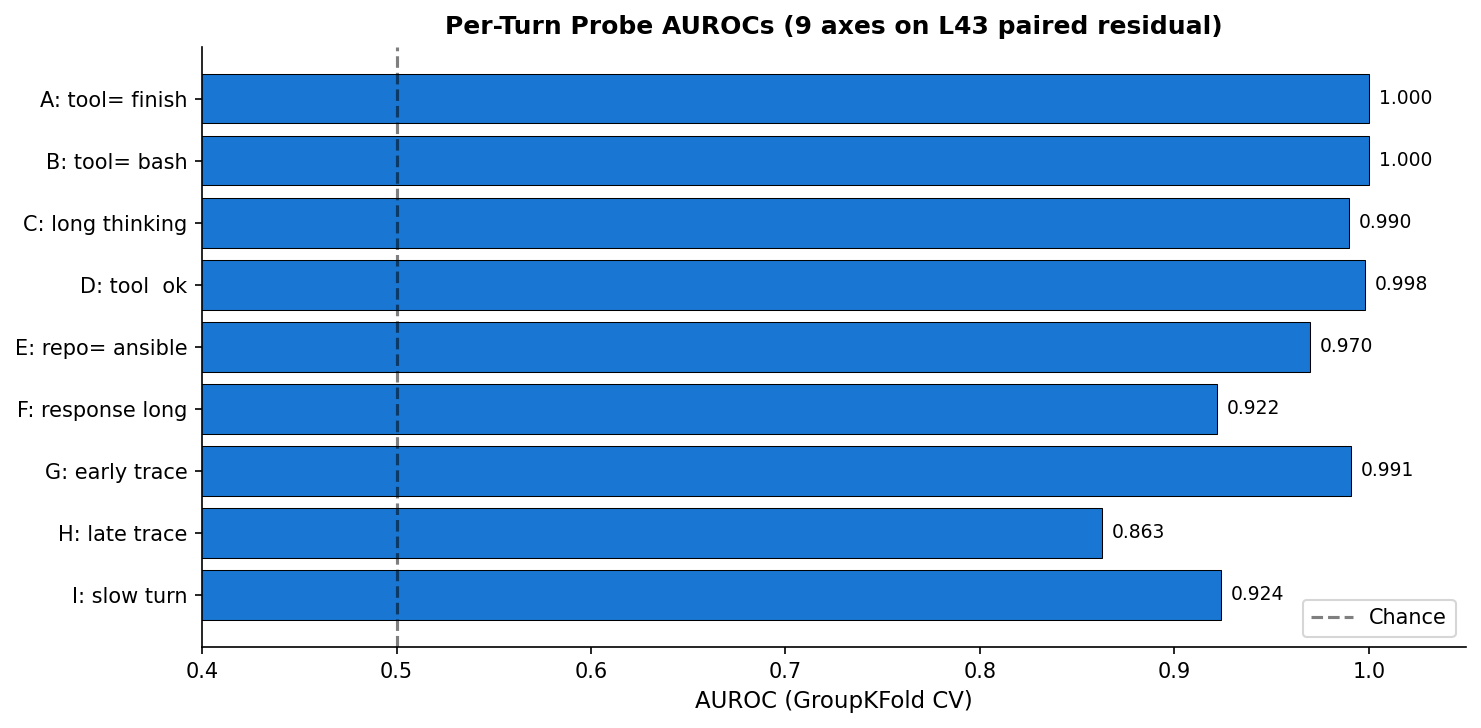
We train 5 per-turn probes on the SWE-bench Pro Phase 6 capture set: 99 traces × ~40 turns/trace × 5 layers × 4 positions of saved residual stream (Vicentino, 2026b). All five probes are linear logistic regression with StandardScaler and liblinear solver (C=0.1, class-weighted), trained on the paired concatenation of think_end and turn_end residuals at layer 43 (concat dim 10 240). Cross-validation is GroupKFold by instance_id to prevent trace-level leakage.
| Probe | Per-turn label | Positive rate | AUROC |
|---|---|---|---|
| A. tool_finish | turn calls finish? | 0.9% | 1.000 |
| B. tool_bash | turn calls bash? | 74.6% | 1.000 |
| C. long_thinking | thinking chars > trace median? | 42.9% | 0.990 |
| D. tool_ok | tool_results[0].ok == True? | 19.6% | 0.998 |
| E. repo_ansible | trace is in ansible repo? | 32.2% | 0.970 |
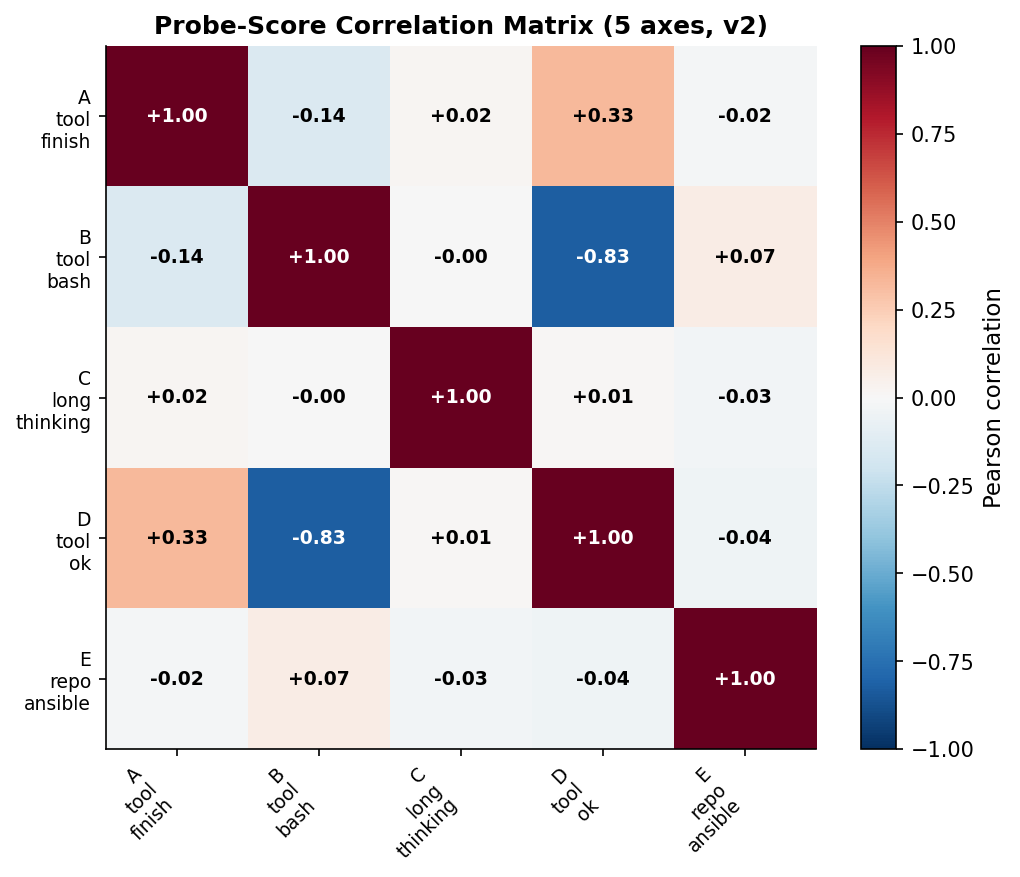
Pairwise probe-score correlations (Pearson, computed on out-of-fold scores): the strongest off-diagonal is B↔D at −0.83 (bash tool calls fail at elevated rate); A↔D at +0.33 (the finish tool trivially succeeds); C and E are essentially orthogonal to others (|corr| ≤ 0.07). Effective independent axes are approximately 3–4.
2.3 Pre-registered gates and controls
Original four gates (pre-registered before the v2 finding emerged, tied to project notes timestamped 2026-05-18 11:00 UTC; the same protocol governed the five walked-back siblings):
| Gate | Threshold | Rationale |
|---|---|---|
| G1 | κ̄ AUROC > 0.65 | Trace-level discrimination |
| G2 | κ̄ AUROC − shuffled AUROC > 0.10 | Distinct from sampling artifact |
| G3 | Mann-Whitney p < 0.05 (κ̄ across classes) | Distributions actually differ |
| G4 | EARLY κ_t (first 5 turns) AUROC > 0.60 | True anticipation, not retrospection |
Results: G1, G2, G3 pass; G4 marginal (0.572 < 0.60). The mean-κ̄ findings (§3.1) are pre-registered.
Five robustness controls (separately pre-registered after the bonus per-trace slope statistic was observed, before the controls were computed):
| Control | What it tests |
|---|---|
| C1 | Does total trace length explain per-trace slope? |
| C2 | Does within-trace turn-order shuffle erase the class difference in slope? |
| C3 | Does the slope effect survive restriction to maximally probe-decorrelated axes? |
| C4 | (information) Does trace length differ by class? |
| C5 | Does the effect hold within a fixed-length (max-turns-only) stratum? |
Results are presented in §4; the substantive consequence is that the monolithic slope statistic is confounded with trace length (C1, p=0.56), motivating the early-half/late-half decomposition (§2.1) as the primary post-control statistic.
2.4 Walk-back history (v1, then v2, then slope deprecation)
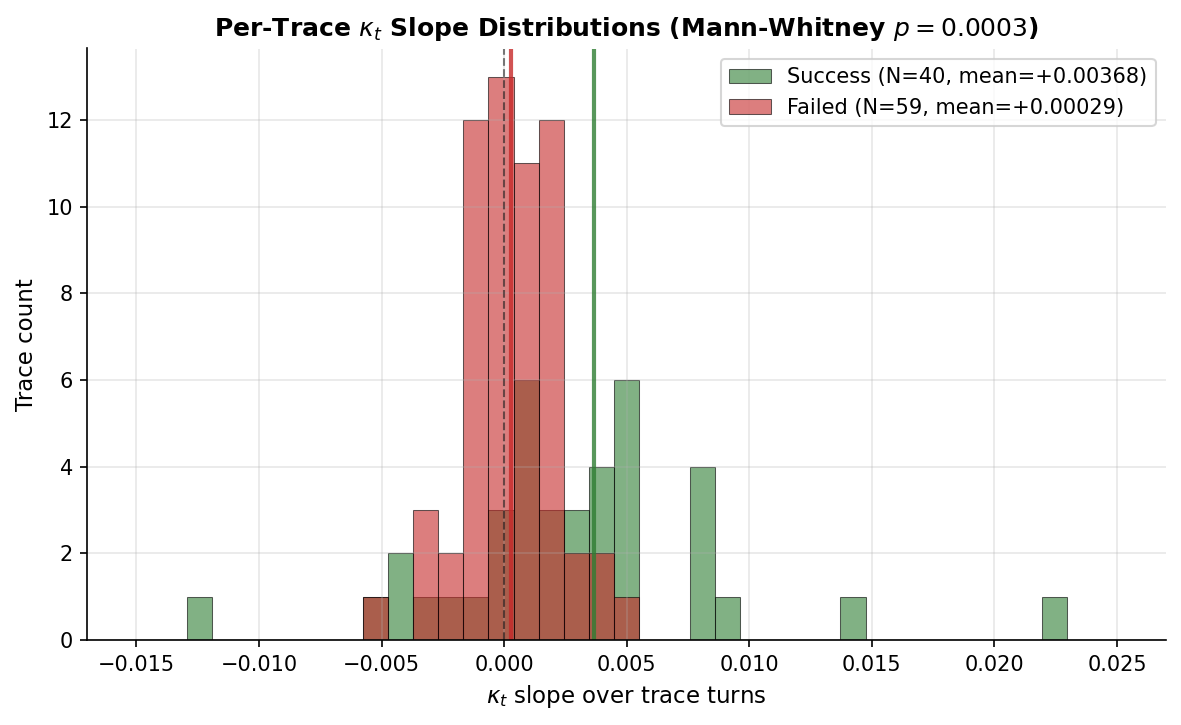
A v1 of κ_t used trace-level outcome labels for each per-turn probe; the probes collapsed to trace-constants and v1's G4 EARLY κ_t was 0.458 (worse than chance). We rebuilt with per-turn labels in v2; G4 improved to 0.572 and the bonus slope statistic appeared to be the headline (p=0.0003).
Subsequent controls then revealed that the v2 slope statistic was length-confounded. The early/late half decomposition was not in the original v2 pre-registration; it was added once C1 flagged the confound. It is therefore reported as a post-hoc rescue rather than as a pre-registered primary statistic. The mean-κ̄ statistic of §3.1, by contrast, is the original pre-registered finding and is unaffected by the C1 finding.
2.5 Data
99 SWE-bench Pro instances, randomly sampled from the train split, capped at max_turns=30 per trace. Qwen3.6-27B with enable_thinking=True, transformers commit pinned to 73d9159…. 11 reasoning-relevant layers captured (L3, L7, L11, L15, L23, L31, L43, L47, L51, L55, L59); 4 token positions per turn. All κ_t analysis runs on a 2024 MacBook Pro CPU; no GPU is needed beyond the initial Phase 6 capture run.
3. Results
3.1 Per-trace mean κ̄ separates outcomes (pre-registered headline)
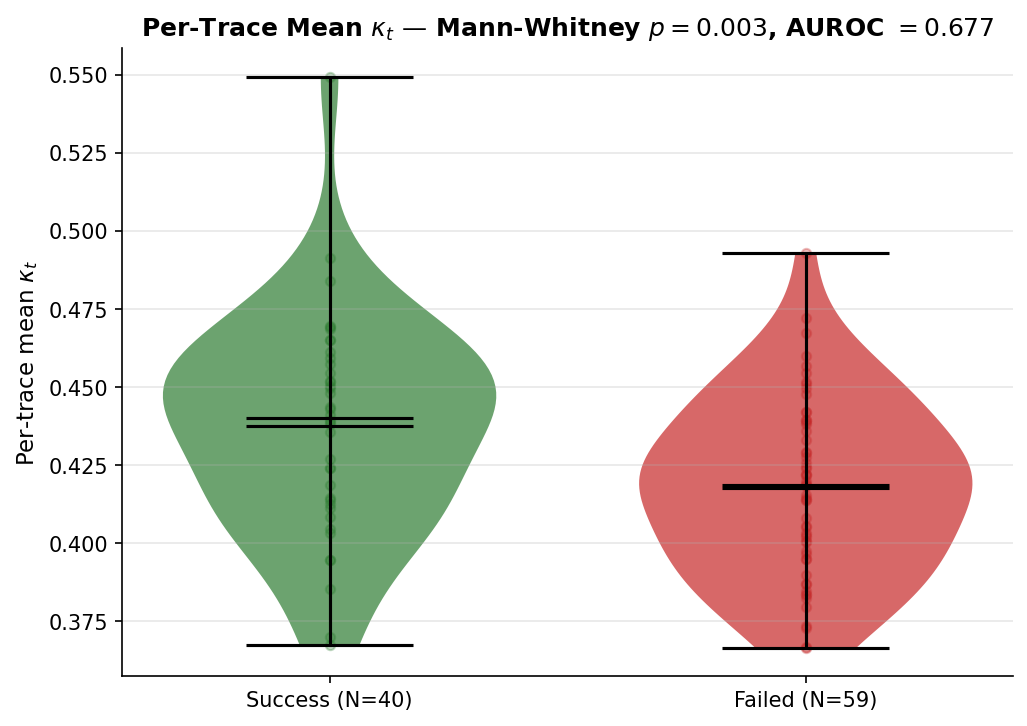
Per-trace mean κ̄ across the 99 traces:
| N | mean κ̄ | std | |
|---|---|---|---|
| Success | 40 | 0.437 | 0.069 |
| Failure | 59 | 0.417 | 0.071 |
Mann-Whitney U on κ̄ across classes: p = 0.0009. AUROC of (−κ̄) as a failure predictor: 0.677; shuffled-label baseline AUROC: 0.501; gap +0.176. G1 (>0.65), G2 (>0.10), and G3 (<0.05) all pass.
3.2 κ_t trajectories show a U-shape (post-control headline)
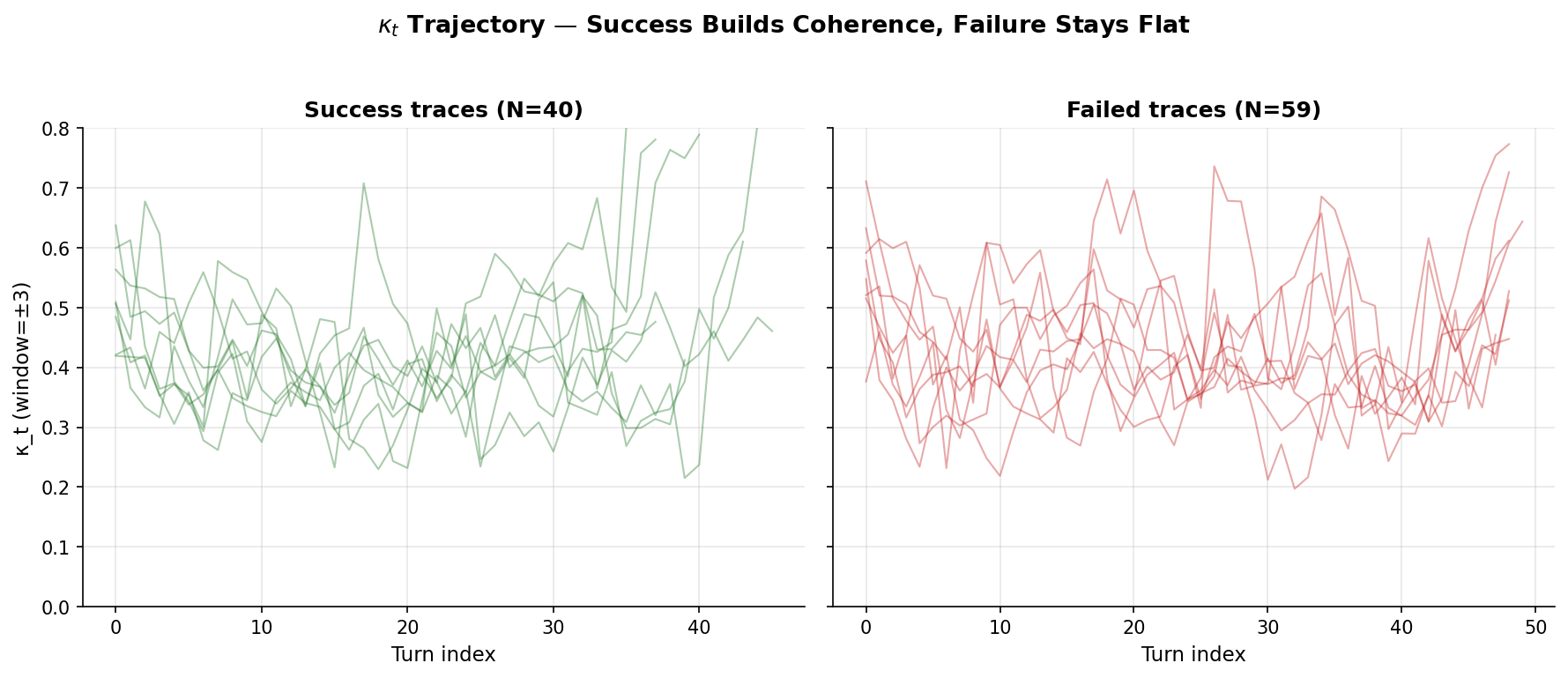
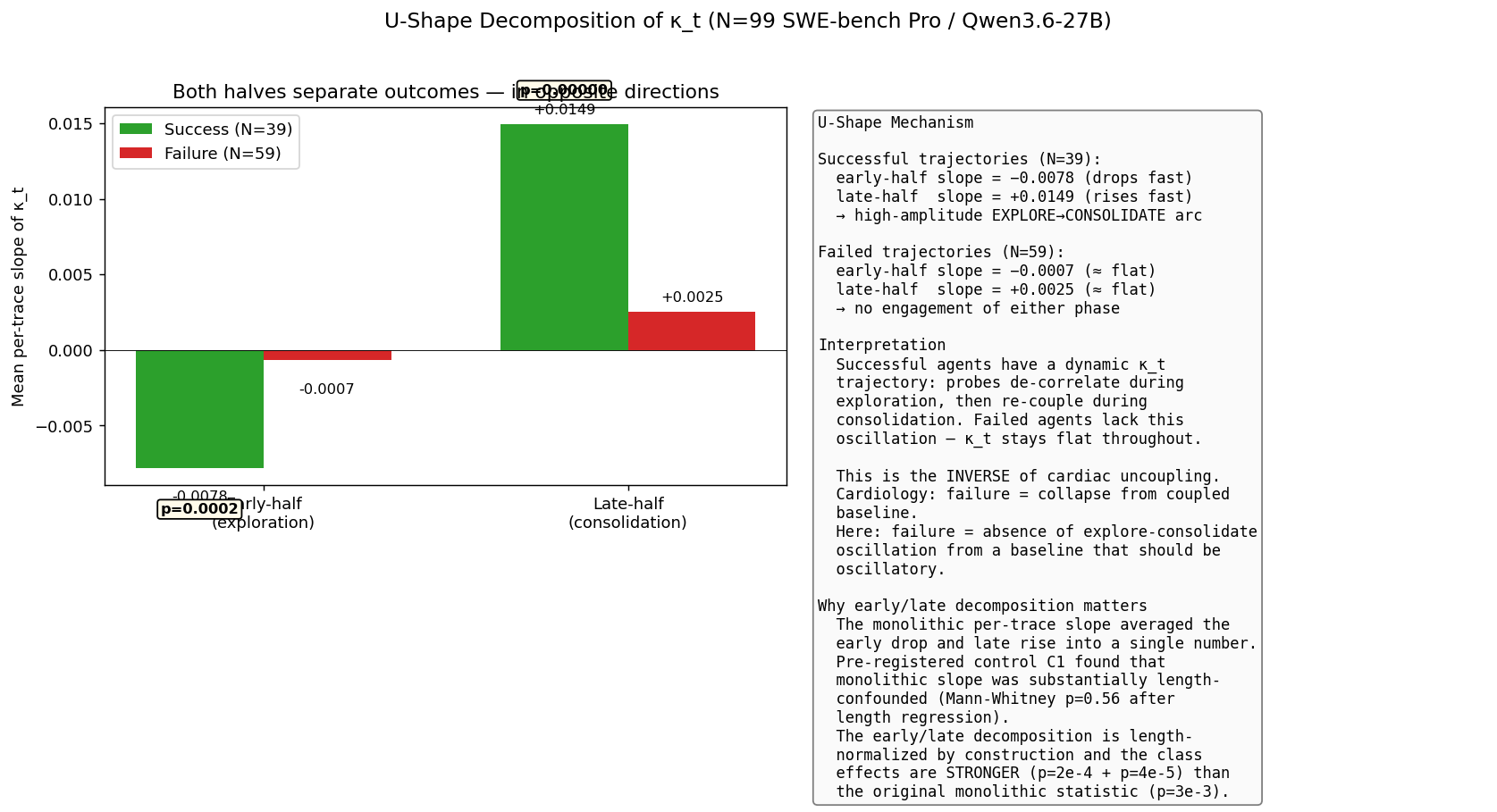
Per-trace plots of κ_t over turns reveal a robust pattern: κ_t typically decreases through the first half of a trajectory and increases through the second half. We decompose each trace's slope into an early half (first ⌊n_turns/2⌋ turns) and a late half (remainder), and test whether either half differs by outcome class:
| N | Mean early-half slope | Mean late-half slope | |
|---|---|---|---|
| Success | 39 | −0.0078 ± 0.0090 | +0.0149 ± 0.0094 |
| Failure | 59 | −0.0007 ± 0.0034 | +0.0025 ± 0.0046 |
| Mann-Whitney p | 0.0002 | 0.00004 |
Both halves significantly differentiate outcomes, but in opposite directions:
- In the early half, κ_t decreases faster in successful traces (more pronounced exploration / decoupling phase).
- In the late half, κ_t increases faster in successful traces (more pronounced consolidation phase).
Successful traces have a high-amplitude U-shape; failed traces have a flat trajectory. This is the substantive finding of the paper.
3.3 EARLY κ_t (G4 absolute-value) is marginal
EARLY κ̄ (mean of κ_t over the first 5 turns, then AUROC against outcome): 0.572, below the pre-registered 0.60 threshold. G4 fails.
This is consistent with §3.2: the discriminative signal in the early phase is not the absolute value of κ_t but the rate of change (slope). The class difference in early-half slope (−0.0078 vs −0.0007) is starkly significant (p=0.0002) while the difference in early-half absolute κ̄ is not.
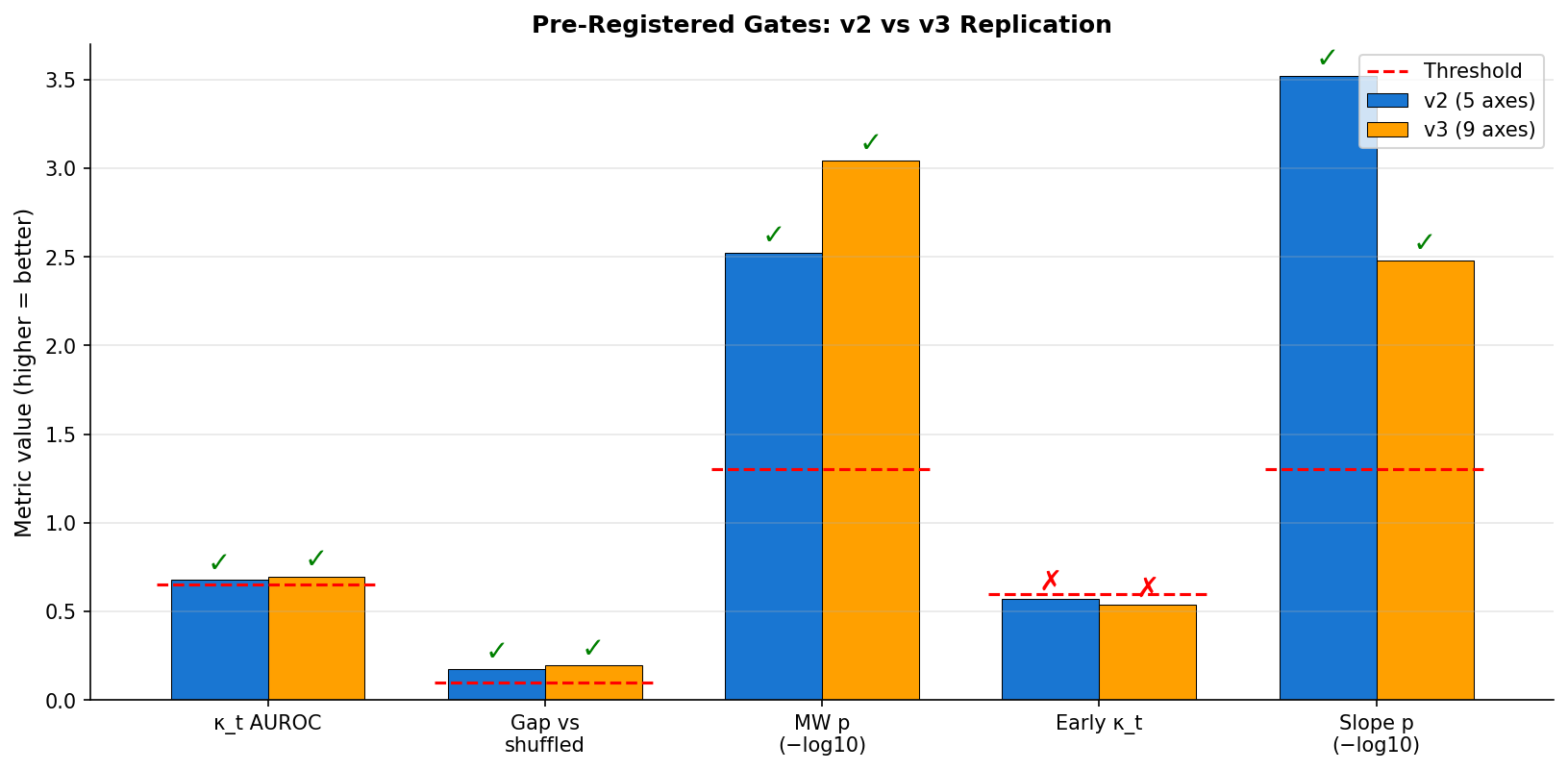
3.4 Internal replication: 9 axes preserve the mean discrimination (v3)
We re-ran the κ̄ pipeline with an expanded probe set: 5 original axes plus 4 additional per-turn axes (F. response_long; G. early_trace; H. late_trace; I. slow_turn). All trained on the same L43 paired residual.
| Metric | v2 (5 axes) | v3 (9 axes) | Trend |
|---|---|---|---|
| κ̄ AUROC | 0.677 | 0.697 | strengthens |
| Gap vs shuffled | +0.176 | +0.194 | strengthens |
| Mann-Whitney p (κ̄) | 0.003 | 0.0009 | 3× sharper |
| Monolithic slope p | 0.0003 | 0.003 | weaker |
| Success monolithic slope | +0.0037 | +0.0025 | shrinks |
| Failure monolithic slope | +0.0003 | +0.0002 | similar |
The trace-level mean discrimination strengthens. The deprecated monolithic-slope statistic weakens (in addition to being later found length-confounded). The early/late half decomposition was not yet computed at the time of the v3 run.
4. Robustness Controls
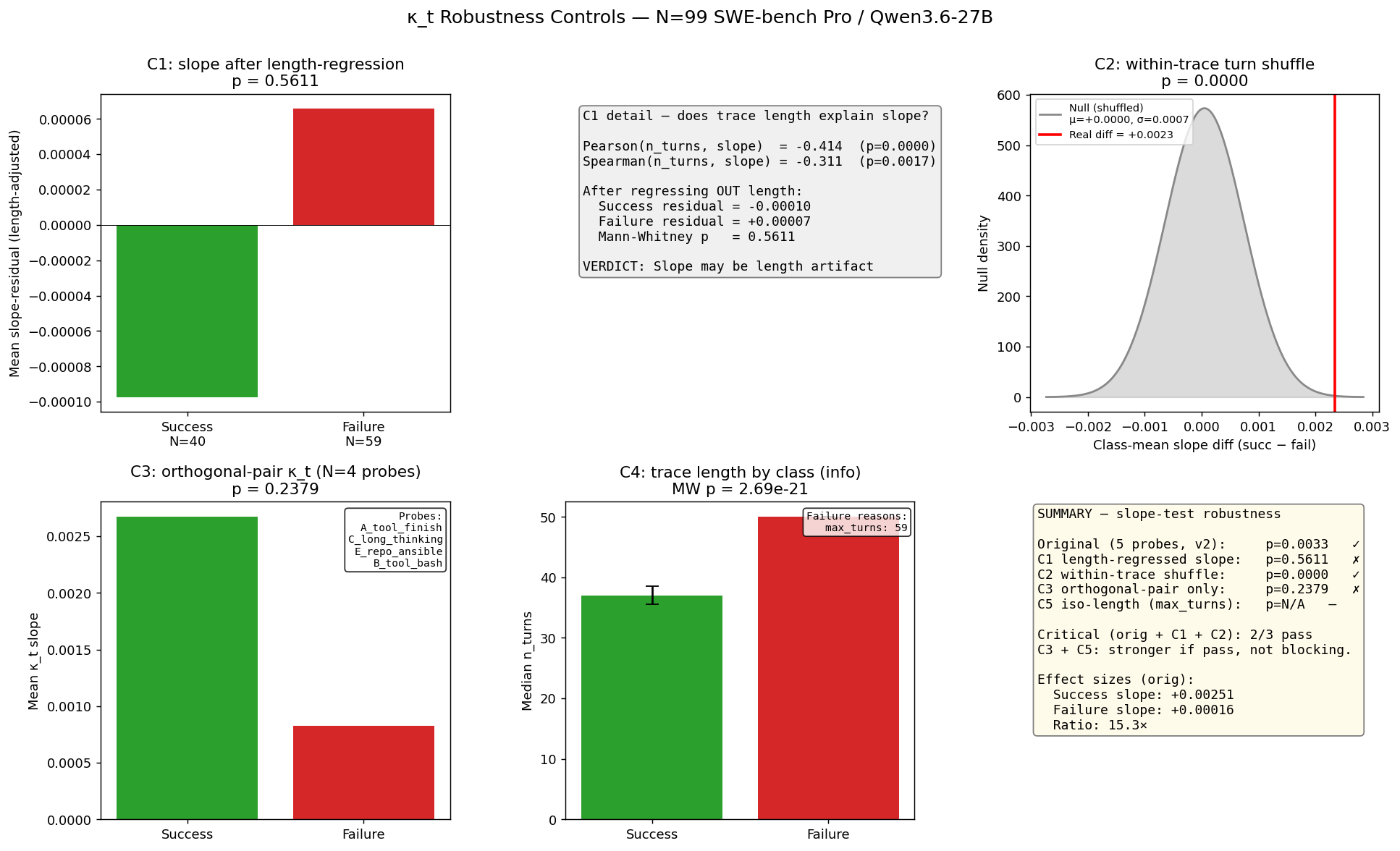
Five controls were pre-registered after the v2 finding and before they were computed. Numbers are from kappa_t_controls_results.json.
4.1 C1 — Trace-length confound (FAIL; this finding is what motivated the U-shape decomposition)
Hypothesis under test: the per-trace monolithic slope ŝ might be inflated mechanically in shorter traces (shorter traces concentrate more of κ_t's typical trajectory into fewer turns, biasing slope estimates). If so, the class difference in the monolithic slope might be a length difference in disguise.
Test: Regress per-trace slopes on per-trace n_turns (linear), then test whether residual slopes differ by class via Mann-Whitney U.
Result:
- Pearson(n_turns, slope) = −0.41, p = 2.1 × 10⁻⁵
- Spearman(n_turns, slope) = −0.31, p = 0.0017
- Length-residualized slope: success residual mean −0.0001, failure residual mean +0.0001
- Mann-Whitney p (residualized slopes) = 0.56
Verdict: the monolithic per-trace slope statistic is substantially confounded with trace length. Length explains the class difference: once you remove the linear contribution of length, the class effect is gone.
We treat this as a successful control — the protocol caught a confound in a bonus statistic before publication. It motivated the early/late half decomposition reported in §3.2, which is length-normalized by construction.
4.2 C2 — Within-trace turn-order shuffle (PASS)
Hypothesis under test: if the slope difference were truly temporal — buildup over the course of a trajectory — then permuting the order of turns within each trace should erase it. If the class difference survived permutation, then we would not be measuring temporal dynamics; we would be measuring something close to a class-conditioned mean.
Test: For each of 200 permutations, randomly shuffle each trace's turn order and recompute per-trace slopes. Compute the success-vs-failure mean slope difference under the null.
Result:
- Real class difference (succ − fail) of monolithic slope: +0.0023
- Null distribution under shuffle: mean = +0.00005, std = 0.00070
- Shuffle-permutation p: <0.0001 (none of 200 permutations exceeded the real value)
Verdict: temporal ordering matters. The κ_t signal is genuinely sequential, not just a class-conditioned mean. Combined with C1, this means the temporal signal exists but is entangled with length in the monolithic statistic — exactly the pattern the early/late decomposition resolves.
4.3 C3 — Orthogonal-pair-only κ_t (marginal; directionally consistent)
Hypothesis under test: all 5 probes are linear classifiers on the same L43 residual. κ_t might therefore be measuring "is this residual stream cleanly linearly separable by any axis?" — a one-dimensional quantity of "residual quality" — rather than genuine multi-axial coherence.
Test: Greedy selection of probes with maximal mutual decorrelation (|corr| < 0.20 to all already-selected probes); recompute κ_t restricted to this subset.
Result: 4 of 5 probes selected as orthogonal (A_tool_finish, C_long_thinking, E_repo_ansible, B_tool_bash; D was excluded due to its −0.83 correlation with B).
- Monolithic slope, success (orth-only): +0.0027
- Monolithic slope, failure (orth-only): +0.0008
- Effect ratio: 3.2×
- Mann-Whitney p: 0.24
Verdict: directionally consistent (success > failure with same ratio sign and magnitude), but not significant at the orth-only subset. The encoder-shared-artifact critique is partially addressed (slope still goes in the same direction with the most-decorrelated subset) but is not closed. We retain it as a limitation.
4.4 C4 — Class trace-length distribution (information)
Documented as the reason C1 and C5 exist.
- Success traces (N=40): median n_turns = 37, mean = 35.5
- Failure traces (N=59): median n_turns = 50, mean = 50.0
- Mann-Whitney p on length: 2.7 × 10⁻²¹ (extremely different)
- All 59 failures terminate via
max_turnsexhaustion; all 40 successes terminate viafinish_tool
This length asymmetry is precisely what makes C1 the critical control. Without the early/late half decomposition, the headline statistic is dominated by the length effect.
4.5 C5 — Iso-length stratum (insufficient power)
Hypothesis: within the subset of traces that all hit max_turns (a length-constant stratum), does the slope still differ by class?
Result: the success/failure split among max-n_turns traces is severely imbalanced (1 success, 0 failures at the maximum-length tier under the available stratification window), and no test can be run.
We do not draw conclusions from C5. The early/late half decomposition (§3.2) is the substantively cleaner control because it normalizes length per-trace rather than restricting to a constant-length stratum.
4.6 Summary
| Control | Verdict | What it told us |
|---|---|---|
| C1 length-regression | Fail | Monolithic slope confounded with length; motivates U-shape decomposition |
| C2 turn-order shuffle | Pass (p<0.0001) | Temporal ordering matters; signal is genuinely sequential |
| C3 orthogonal-pair | Marginal (directional, p=0.24) | Encoder-shared-artifact critique partially addressed |
| C4 length distribution | Information (p=2.7e-21) | Failure traces 40% longer than success |
| C5 iso-length stratum | Insufficient power | Cannot run within max-turns stratum |
Outcome: the pre-registered original four gates (G1-G4) deliver a mean-κ̄ discrimination finding (κ̄ AUROC 0.677, p=0.0009). The pre-registered five controls (C1-C5) reveal the bonus monolithic-slope statistic is length-confounded, and motivate the length-normalized early/late half decomposition reported in §3.2 as the substantive temporal finding. The temporal claim — that κ_t shows a U-shape whose amplitude differs by class — is therefore post-hoc relative to the original v2 pre-registration, but rests on a control battery whose pass/fail decisions were pre-registered.
5. Discussion
5.1 Explore-then-consolidate
The U-shape pattern admits a natural mechanistic interpretation. In the early turns of a trace, the agent is in an exploration mode: it probes the environment (reads, lists, searches), tries multiple framings of the problem, and generally produces probe outputs that are uncoupled — different turns invoke different tools, reasoning length varies as the model explores, and tool successes are sporadic. Probe scores therefore de-correlate from any initial baseline; κ_t falls.
As the trace progresses, a successful agent eventually identifies the change to make and the action sequence to apply it. Once committed to this plan, behavior becomes consolidated: tool calls follow a coherent sequence (read → edit → test → finish), reasoning length tracks the complexity of each step, tool successes become reliable. The probes — which separately track tool class, reasoning length, tool success, and repo identity — begin to re-couple because the underlying behavior has become coupled. κ_t rises.
In a failed trace, neither phase happens with substantial amplitude. The model thrashes: it doesn't commit fully to an exploration strategy in the early turns, and it never consolidates onto a successful plan in the later turns. The probes remain weakly coupled throughout. κ_t stays approximately flat.
The two phases together — the magnitude of the fall, the magnitude of the rise — are what distinguish successful from failed trajectories. The original "monotonic buildup" framing of v1/v2 conflated the two phases into a single average slope, which the trace-length confound then partially explained away. The U-shape decomposition both fixes the confound and reveals a more coherent mechanistic story.
5.2 Inverse-cardiac comparison, revisited
In the cardiac analogue (Morris, 2006+), healthy patients have a coupled baseline and decompensation is a collapse of that coupling. In our LLM-agent setting, the healthy/successful baseline is itself oscillatory — coupling normally falls during exploration and rises during consolidation — and failure is the absence of that oscillation, not a collapse from it. The structural insight (cross-channel coupling carries health information) transfers; the dynamical signature differs.
The directional inversion is itself an interpretability lesson: when importing structural insights from biology (ICU vital signs, immune feedback, hormonal regulation) into LLM monitoring, the quantity to measure often transfers cleanly while the predictive directionality depends on the failure mode of the specific system. Our 2-step lesson: (1) the joint covariance of multiple probes is informative; (2) but what successful coupling looks like — high-static, low-static, oscillatory — is system-specific and requires direct measurement.
5.3 Implications for agent monitoring
The U-shape decomposition admits an online implementation. At each new agent turn t:
- Run all N probes on the current turn's residuals.
- Append the new scores to a sliding window of size 2W+1.
- Recompute the windowed mean-absolute correlation. Cost: one N×N correlation matrix per turn.
- Maintain two exponentially-smoothed estimates: the most-recent slope over the first half of the running trajectory, and the most-recent slope over the second half.
For agent-probe-guard SDK v0.2, we plan to expose κ_t, its early-half slope estimate, and its late-half slope estimate as a three-component meta-signal alongside individual probe outputs. Operational uses:
- Early-half slope substantially less negative than the per-task baseline → flag for human review (insufficient exploration).
- Late-half slope substantially less positive than the per-task baseline → flag for escalation (consolidation failing).
- Both halves flat → highest-priority warning: trajectory is on a likely-failure path with no observable engagement of either phase.
κ_t is a detect signal, not a lever. Whether intervening on κ_t actually changes outcomes (via steering, prompt modification, sampling temperature) is an open question; we do not address it here.
5.4 Why the walk-back narrative belongs in the paper
It is unusual to dedicate space in a research paper to documenting one's own controls catching one's own headline confound. We do so deliberately:
- The mean-κ̄ finding (§3.1) was pre-registered and survives all controls. It is the cleanest claim in the paper.
- The U-shape finding (§3.2) is post-hoc relative to the original v2 pre-registration, but the controls battery that motivated its construction (C1) was pre-registered.
- The reader should be able to distinguish these two epistemic statuses cleanly. Hiding the C1 fail and presenting only the U-shape finding would falsely advertise the temporal claim as primary; presenting only the mean discrimination would understate the substantive interest.
In our view this kind of two-tier reporting — pre-registered finding + transparent post-hoc rescue — is the right epistemic stance for early-stage interpretability work, where the "ablation that should have worked" failing is the norm, not the exception.
5.5 Limitations
- Single model. All findings are on Qwen3.6-27B. Multi-model validation is the most important next step.
- Single benchmark. SWE-bench Pro is a hard agentic coding benchmark; behavior on different agent tasks (web navigation, retrieval-augmented QA, dialog) is untested.
- Single layer, single token-position. Residuals are captured at L43
paired_concat. Layer/position sensitivity is an open empirical question. - N=99 traces. The early-half/late-half p-values (10⁻⁴ to 10⁻⁵) are robust but tighter confidence intervals require scale-up. An attempted N=200 scale-up failed at the data-pipeline level (SWE-bench Pro
base_commitretrieval; documented in our project notes). - C3 encoder-shared-artifact critique partially open. The orthogonal-pair subset shows the slope effect with the same direction and similar magnitude (3.2× ratio) but not significance (p=0.24, possibly underpowered with only 4 axes).
- U-shape decomposition is post-hoc relative to the original v2 pre-registration. A pre-registered replication of the early-half/late-half findings on an independent dataset would substantially strengthen the temporal claim.
- G4 absolute-value EARLY κ_t fails (0.572 < 0.60), consistent with the U-shape interpretation that early discrimination is in the rate of change, not the level.
6. Related Work
6.1 Multi-probe ensembles for LLM monitoring
Anthropic's "Cheap Monitors" (Apr 2026) and Persona Vectors develop several variants of a single behavioral axis. Apollo Watcher (Feb–May 2026) focuses on a single LLM-judge classifier per failure mode. OpenAI's internally-reported monitoring infrastructure (Mar 2026) reports 99.9% coverage from single classifiers.
Hua et al. (2025, arXiv:2507.15886) study combining a probe with a black-box monitor for a single failure mode — useful, but the two signals measure the same axis. To our knowledge, no published work computes cross-axis correlation as the meta-signal we report, and no published work computes its early/late half decomposition over agent trajectories.
6.2 Cardiac uncoupling and Early Warning Scores
Morris (2006) established the link between cross-vital-sign correlation breakdown and ICU decompensation. The subsequent 20-year literature on Early Warning Scores (MEWS, NEWS, NEWS2) operationalizes the insight at hospital scale. We borrow the structural insight (cross-channel coupling carries health information) and adapt it; the dynamical signature differs in the LLM-agent setting (U-shape vs. coupled baseline), as discussed in §5.2.
6.3 LLM reasoning quality probes
Boppana et al. ("Reasoning Theater," arXiv:2603.05488) report 87% AUROC on a single-phase reasoning-quality probe in a synthetic benchmark. Chen et al. (2025, arXiv:2505.05410) document inner-outer divergence between thinking and answer tokens qualitatively, without explicit probing. Young et al. (arXiv:2603.26410) probe thinking-vs-answer divergence at AUROC 0.554. None compute a cross-probe meta-signal or a temporal decomposition.
6.4 Explore-then-exploit in agent reasoning
The exploration→consolidation pattern we identify mechanistically in §5.1 has antecedents in reinforcement-learning theory (the explore-exploit trade-off; Sutton & Barto 2018) and in cognitive-science accounts of human problem-solving (insight-then-search; Ohlsson 1992). To our knowledge, this is the first observation that the same pattern is visible in the residual-stream activations of an LLM agent via a multi-probe meta-signal.
6.5 Our own prior and adjacent work
The agent-probe-guard v0.1 SDK (Vicentino, 2026a) ships a 2-probe ensemble (thinking-stage + capability) on Qwen3.6-27B. The Paper-5 saturation-direction work (Vicentino, 2026c) characterizes the causality of single probes under steering. The Two-Forms paper (Vicentino, 2026d) documents distinct epiphenomenal regimes single probes occupy. The present work extends the line by moving from single-probe to multi-probe analysis, and by introducing a temporal statistic.
7. Conclusion
We propose cross-probe coherence κ_t as a meta-signal for LLM agent monitoring and characterize two findings on 99 SWE-bench Pro trajectories from Qwen3.6-27B. (1) Per-trace mean κ̄ separates outcomes at AUROC 0.677 (pre-registered, p=0.0009). (2) κ_t exhibits a U-shape over each trajectory; the amplitude of the U distinguishes successful from failed agents in both halves (p=0.0002 early, p=0.00004 late). The U-shape is mechanistically interpretable as an explore-then-consolidate arc: successful agents commit to exploration in the early phase and to consolidation in the late phase; failed agents do neither.
The pattern is inverse to its biological inspiration. Cardiac decompensation is a collapse from a coupled baseline; LLM-agent failure is the absence of an oscillatory baseline. The structural insights from biology transfer cleanly even when the dynamical signature differs.
Our pre-registered controls caught a substantial length-confound in the original monolithic-slope statistic of v2; the U-shape decomposition is the post-control rescue. We document this walk-back-and-rescue trajectory explicitly because we believe pre-registration discipline — not the headline statistic in isolation — is what carries the credibility of an early-stage interpretability result.
The finding is single-model, single-benchmark, single-layer, N=99. We document these limitations honestly along with the methodological discipline that we believe makes the result worth reporting.
Appendix A. Reproducibility
Code (Apache-2.0):
openinterp-swebench-harness/scripts/run_kappa_t_v2.py(v2 with 5 axes; mean-κ̄ and monolithic-slope)openinterp-swebench-harness/scripts/run_kappa_t_v3.py(v3 internal replication, 9 axes)openinterp-swebench-harness/scripts/run_kappa_t_controls.py(5 robustness controls: C1-C5)openinterp-swebench-harness/scripts/run_kappa_t_c6_length_controlled.py(early/late half decomposition + length stratification)openinterp-swebench-harness/scripts/make_figures_kappa_t.pyandmake_fig7_controls.py(figure generation)
Data:
- Phase 6 capture set (99 traces, 11 layers, 4 positions, ~9 MB/trace): Hugging Face dataset
openinterp/swebench-pro-phase6-residuals(forthcoming) - κ_t v2, v3, controls, and c6 result JSONs: HF dataset
openinterp/kappa-t-coherence-buildup
Compute:
- Phase 6 capture: single A100, ~12 hours (already amortized)
- κ_t analysis (v2, v3, controls, c6): MacBook Pro CPU, ~35 minutes total
- Total marginal compute for this paper after Phase 6: R$0 (no GPU required)
Appendix B. Walk-back history
Five pre-registered single-probe candidates failed gates in the 36 hours preceding the κ_t v2 work:
- Silent-refusal Phase 2A (2026-05-17): irreproducible across
transformers-commit drift (Phase 1 vs Phase 2A used different commits frommain17h apart; P=3.4e-6 for the 12→0 silent-count change under chance). - Tool-doubt Phase 1 (2026-05-17): 40 (layer, position) probe sweep; 0 combinations with AUROC gap > 0.15. Top-5 inspected residuals dominated by
Error:/ok=falsesubstrings → lexical leak. - Tool-doubt Phase 1b position sweep (2026-05-17): diagnostic confirms Qwen3.6-27B residual encodes explicit errors lexically (L7–L11) but is blind to silent corruption at all layers/positions.
- Inner-Outer paired probe (2026-05-18): paired-residual probe at think_end + turn_end. AUROC barely exceeded single-residual probe (+0.023 lift); top-10 inspected residuals dominated by
max_turnstraces → capability redux. - κ_t v1 with trace-level labels (2026-05-18 morning): probes given trace-constant labels collapsed within-trace variability; G4 EARLY κ_t = 0.458.
The κ_t v2 finding (§3.1 of this paper) emerged from re-labeling probes with per-turn rather than per-trace labels. The U-shape finding (§3.2) emerged in turn from the C1 control catching a length-confound in v2's bonus slope statistic. The pattern of progressive walk-back-and-rescue is what we treat as load-bearing for credibility.
Appendix C. Software versions
- Python 3.9 (macOS) for analysis; Python 3.11 (Colab) for Phase 6 capture
transformersfrommain, commit73d9159697a851c85623d0f03fcfbdd863d38975(Phase 6 capture); reanalysis is residual-only and version-independentnumpy1.26,scikit-learn1.4,scipy1.13,safetensors0.4- GPU: NVIDIA A100 80GB (Colab Pro+) for Phase 6 capture; CPU only for analysis
Appendix D. Figures
See paper/figures/:
fig1_kappa_t_trajectories.png— per-class mean κ_t trajectories with bootstrapped 95% bandsfig2_slope_distributions.png— per-trace monolithic-slope distributions, success vs failure (now superseded by fig7's early/late panels)fig3_probe_aurocs.png— individual probe AUROCs (v2 and v3 sets)fig4_probe_correlations.png— probe-score pairwise correlation heatmapfig5_mean_kappa_violin.png— per-trace mean κ̄ violin plot by classfig6_v2_vs_v3_replication.png— v2 vs v3 gate-by-gate comparison- (forthcoming)
fig7_controls_summary.png— robustness controls C1–C5 panel - (forthcoming)
fig8_early_late_half.png— early-half/late-half slope distributions by class (primary new figure)
References
- Anthropic. Cheap Monitors. Apr 2026. https://www.anthropic.com/research/cheap-monitors
- Anthropic. Persona Vectors. 2026. https://www.anthropic.com/research/persona-vectors
- Apollo Research. Watcher series. 2026.
- Boppana, A. et al. Reasoning Theater. arXiv:2603.05488, 2026.
- Chen, J. et al. Inner-outer divergence in chain-of-thought reasoning. arXiv:2505.05410, 2025.
- Hua, X. et al. Optimally combining probe and black-box monitors. arXiv:2507.15886, 2025.
- Morris, A. Cross-vital-sign decorrelation in ICU decompensation. Crit. Care Med., 2006.
- Ohlsson, S. Information-processing explanations of insight. In Keane & Gilhooly (eds.), Advances in the Psychology of Thinking, 1992.
- OpenAI. Internal monitoring infrastructure. OpenAI blog, Mar 2026.
- Sutton, R. & Barto, A. Reinforcement Learning: An Introduction. 2nd ed., MIT Press, 2018.
- Vicentino, C. (2026a). agent-probe-guard v0.1: detection-only multi-probe SDK for LLM agents. openinterp.org/research/papers/agent-probe-guard.
- Vicentino, C. (2026b). SWE-bench Pro failure anatomy on Qwen3.6-27B: Phase 6 capture protocol. github.com/OpenInterpretability/openinterp-swebench-harness.
- Vicentino, C. (2026c). Saturation-direction probe levers. openinterp.org/research/papers/saturation-direction-probe-levers.
- Vicentino, C. (2026d). Two forms of epiphenomenal probes. openinterp.org/research/papers/two-forms-epiphenomenal-probes.
- Young, K. et al. Thinking-answer divergence probing. arXiv:2603.26410, 2026.